Framework
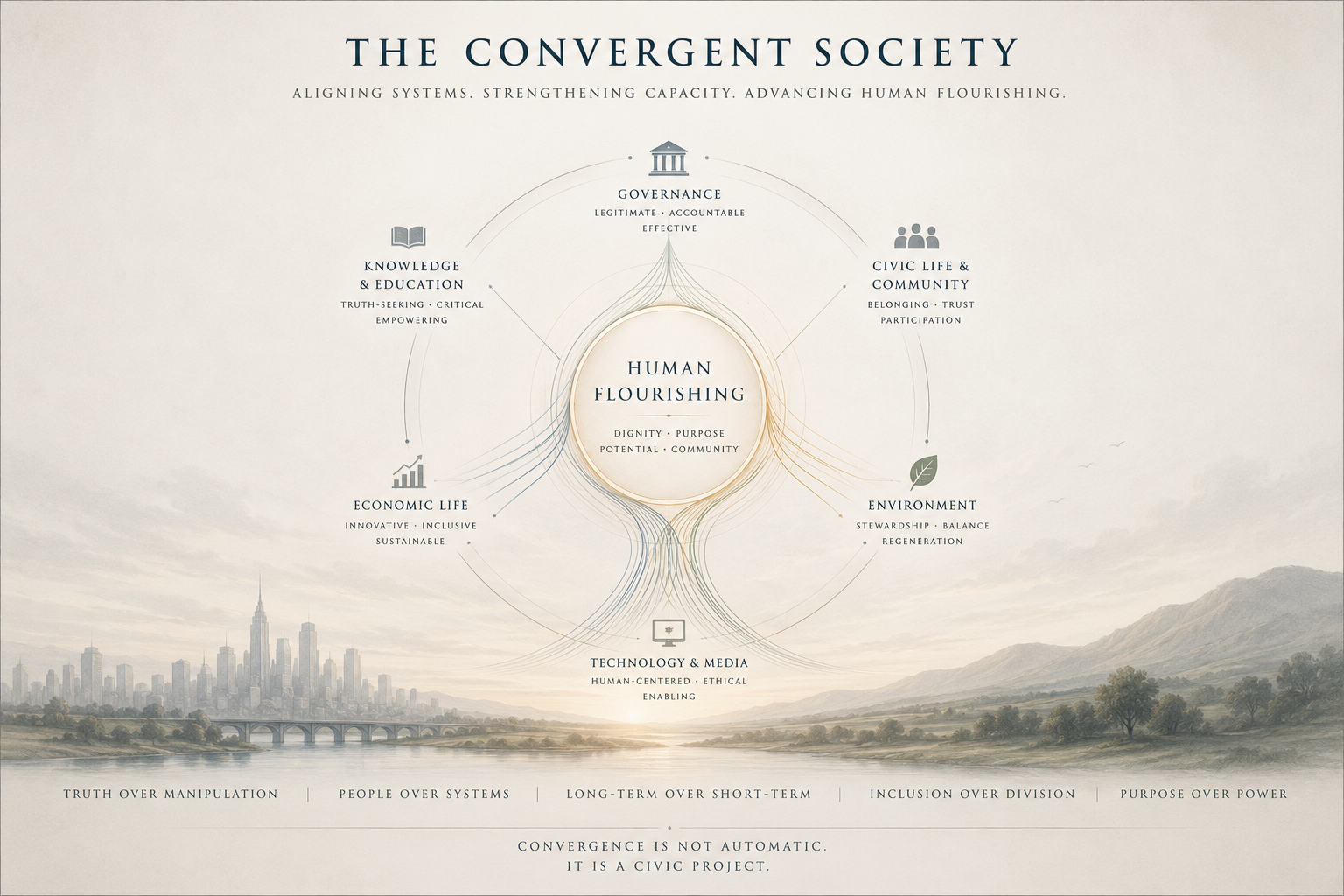
This framework sets out a structured approach to understanding how modern societies become misaligned with human flourishing—and how that alignment can be restored.
Core Premise
Modern societies are not failing primarily due to a lack of resources or knowledge. They are failing because the systems that organize economic life, political institutions, and social experience have drifted away from the human being they are meant to serve.
In this context, “systems” refers to the institutional arrangements, incentives, rules, infrastructures, narratives, and power relations through which essential social functions are carried out. They are not fixed or isolated sectors, but interacting structures that shape lived experience.
This misalignment does not occur suddenly. It emerges through gradual institutional drift, becomes structured through adaptation, and persists through forms of capture that generate advantages within fragmented systems.
The Human Point of Reference
The Convergent Society framework begins with a simple premise: societies must be understood in relation to the human beings they are meant to serve.
This is not a narrow view of the individual as consumer, worker, voter, taxpayer, or economic actor. Those are partial descriptions. They capture important aspects of human life, but none of them is sufficient.
The human person is embodied, relational, historical, moral, emotional, rational, vulnerable, creative, and capable of meaning. Each person is born into a family, a language, a culture, a memory, and a world of inherited obligations and possibilities. Human beings think, feel, suffer, love, judge, remember, imagine, believe, create, and act. They are biological organisms, but never merely biological organisms. They are individual selves, but never self-created selves.
This fuller account of the person is the foundation of the framework.
Human flourishing names the development of the person at the scale of a single life. It refers to the conditions under which human beings can grow in dignity, agency, belonging, purpose, moral responsibility, creativity, security, and meaning.
Civic capacity names the development of the person at the scale of collective life. It refers to the shared abilities, institutions, relationships, norms, and forms of trust that allow people to live together, govern themselves, solve common problems, and renew society over time.
The person comes first. Flourishing and civic capacity are not separate foundations but expressions of the same foundation at different scales: the human life and the shared life.
This is why structural divergence matters. A society diverges when its systems begin to operate according to logics that no longer serve the full human person. Economies, institutions, technologies, and forms of governance may continue to function, expand, and become more efficient while becoming increasingly disconnected from dignity, meaning, belonging, agency, responsibility, and shared purpose.
The purpose of the framework is to make that divergence visible and to describe the capacities required to repair it.
Convergence, in this sense, is not uniformity, control, or centralized design. It is the realignment of social systems with the full human person and with the conditions that allow persons and communities to develop together.
Systems Thinking
The Convergent Society project uses systems thinking to understand society as an interconnected architecture of institutions, incentives, technologies, narratives, and power relations. Its central question is not only what problems exist, but what the system is organized to produce.
This matters because many social harms are not isolated failures. They are recurring outcomes generated by the way systems are designed, measured, governed, and rewarded. Inequality, alienation, institutional mistrust, democratic erosion, care fragmentation, and social exhaustion often persist because existing arrangements make them normal, rational, profitable, or difficult to see.
Systems thinking therefore allows the project to identify structural incoherence: the gap between the human values a society claims to uphold and the institutional logic through which it actually operates.
The Problem: Divergence
Across domains, key systems increasingly operate out of alignment with one another and with the conditions required for human flourishing.
This produces:
fragmentation of care and essential services
disconnection between economic growth and human well-being
erosion of trust and civic belonging
increasing complexity and inaccessibility
shifting of risk and cost onto individuals
These are not isolated failures. They are expressions of a broader condition of structural divergence.
The Framework
The Convergent Society Framework is organized around three interdependent components:
Diagnosis
Identifies where and how systems become misaligned with human needs.
Key concepts:
Drift
Fragmentation
Divergence
Capture
Measurement (Indices)
Makes alignment and misalignment observable.
The framework includes the development of a Convergent Society Index, structured around a small number of dimensions such as:
care coherence
institutional alignment
civic belonging
productive alignment
intergenerational balance
These are not abstract indicators. They are intended to make visible where systems fail to support human flourishing.
Transformation Under Capture
Mechanisms of Transformation
Explains how change becomes possible.
Misaligned systems persist because:
actors adapt to them
advantages are captured within them
resistance to change becomes structured
Transformation therefore requires:
exposing patterns of divergence and capture
measuring their effects
building counter-institutions
sequencing reform under constraint
forming coalitions capable of sustaining change
Rapid Societal Response Capacity
Transformation under conditions of capture requires that society be able to recognize and organize around emerging domains of power before they become structurally entrenched.
New systems—such as artificial intelligence, financial innovations, or platform infrastructures—tend to scale rapidly under concentrated control. Without timely coordination, they are shaped by a narrow set of actors. A convergent society must develop the capacity to respond earlier: to align institutions, define boundaries, and embed human purposes before these systems lock in their trajectory.
Transformation therefore depends not only on restraining power, but on the ability of society to organize fast enough to shape it.
Architectural Direction
The framework is not only diagnostic. It is also directional.
The Convergent Society, as developed in the book, outlines an architectural approach to organizing institutions around human needs. Rather than treating systems as separate or self-contained, it emphasizes their coherence and alignment across the dimensions that shape lived experience.
This does not take the form of a fixed model. It is a set of guiding principles for how systems relate and function together:
coherence across institutional functions
accessibility and clarity in everyday experience
alignment between institutional outcomes and human development
reduction of unnecessary fragmentation and complexity
continuity across conditions and life stages
The aim is not to define a single structure, but to establish the conditions under which institutions can operate as a coherent whole.
Scope
This framework does not propose a single model or policy program.
It provides:
a way to diagnose systemic misalignment
a structure for measurement
a basis for institutional redesign
Its purpose is to support the gradual realignment of complex societies toward human-centered outcomes.
Closing
The central challenge is not simply to improve individual systems, but to restore alignment across them.