Core Concepts
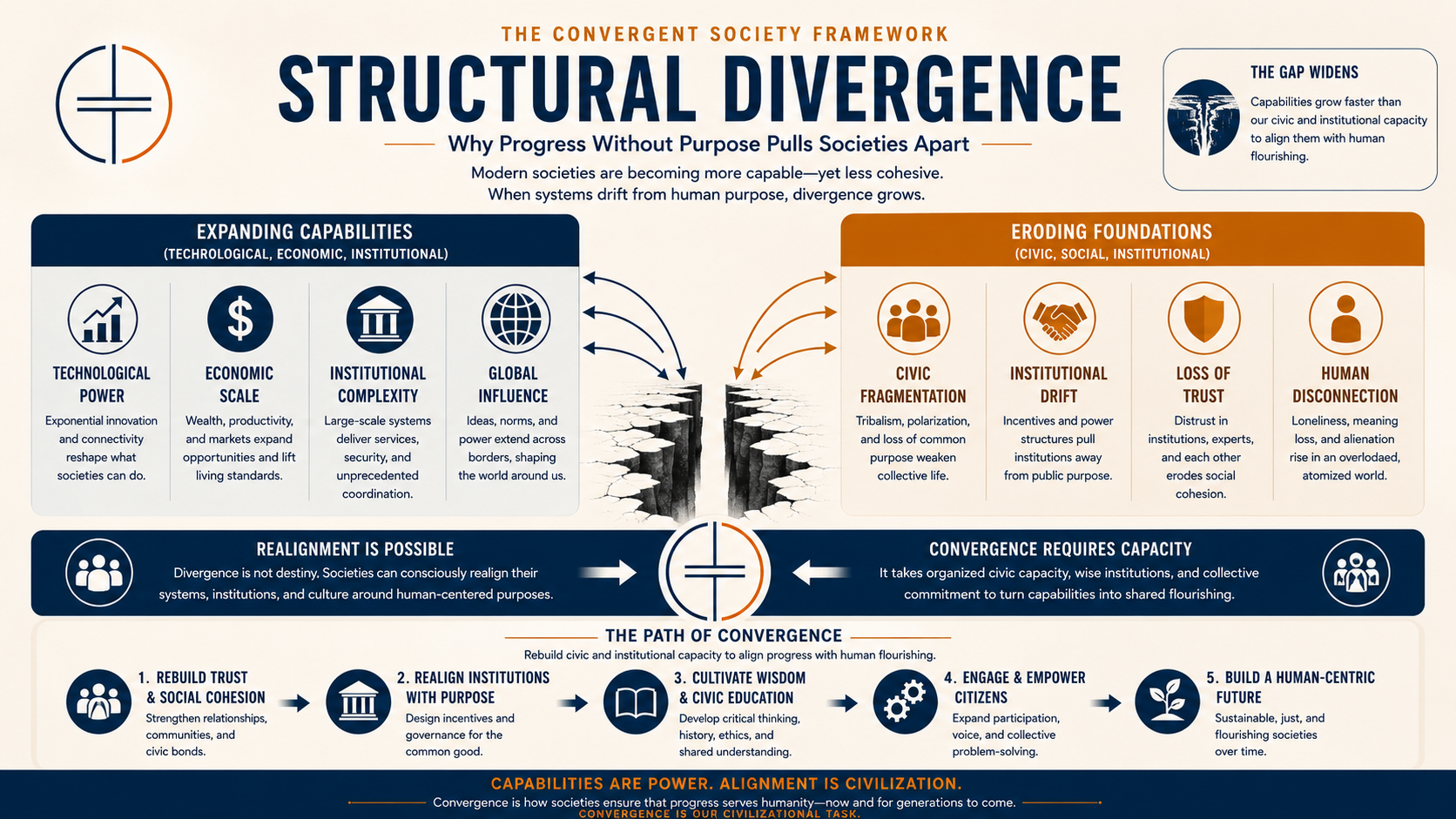
The Convergent Society is a human-centered civic framework that seeks to understand and respond to the growing divergence between modern institutional systems and the human purposes they are meant to serve. It proposes that societies require not only economic and technological progress, but also the civic, institutional, educational, and operational capacity to sustain trust, belonging, democratic participation, and human flourishing over time.
Diagnosing Divergence
Structural divergence describes the gradual separation between the capabilities of modern systems and the broader human purposes they are meant to serve. Economic, technological, political, and institutional systems may continue advancing in complexity and efficiency while becoming increasingly disconnected from human flourishing, civic cohesion, and long term societal well being.
Structural Incoherence
Structural incoherence occurs when the institutions, incentives, rules, and systems that organize collective life no longer work together in ways that support their broader social purposes. Individual institutions may continue operating effectively according to their own internal measures while their combined effects weaken human flourishing, civic trust, democratic legitimacy, or the society’s capacity to respond to shared problems. Structural incoherence is one of the principal mechanisms through which structural divergence is produced and sustained.
Institutional Drift
Institutional drift occurs when institutions gradually move away from their original public or civic purpose as incentives, power structures, cultural norms, or economic pressures change over time. Institutions often continue functioning formally while becoming progressively less aligned with the needs and expectations of the societies they are meant to serve.
Human Foundations
Human Flourishing
Human flourishing refers to the conditions that allow individuals and communities not merely to survive materially, but to live meaningful, dignified, healthy, connected, and fully developed lives. It includes economic security, opportunity, belonging, civic participation, education, purpose, and the ability to develop human capabilities across generations.
Civic Capacity
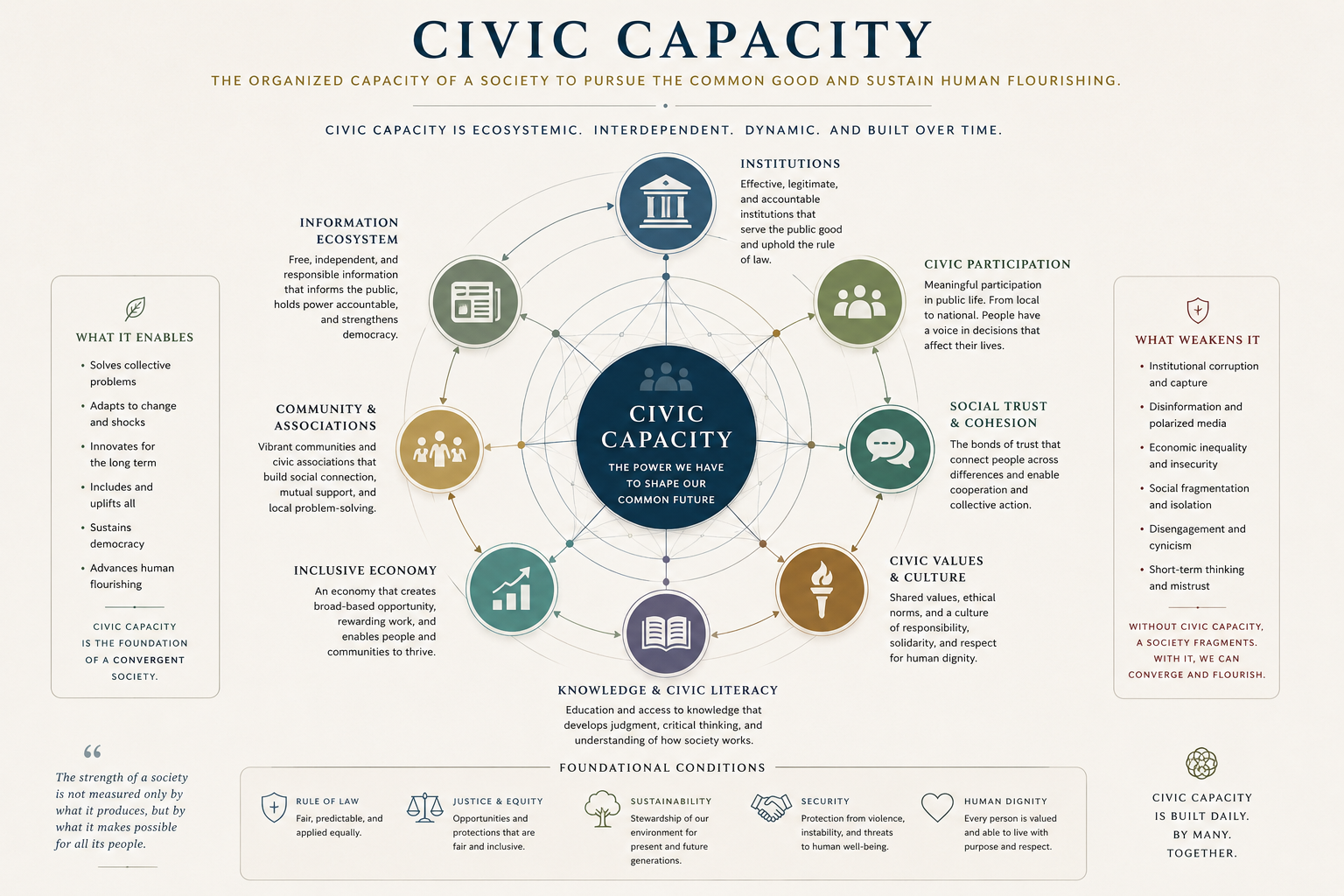
Civic capacity refers to the ability of a society to organize collective life around shared purposes over time. It includes public trust, civic participation, institutional legitimacy, social cooperation, democratic norms, civic education, and the broader cultural foundations that allow complex societies to function cohesively without descending into fragmentation and antagonism.
Transformation and Renewal
Transformation Under Capture
Transformation under capture refers to the challenge of pursuing meaningful societal renewal under conditions where major institutions, economic systems, political structures, or technological systems have become increasingly shaped by concentrated power, entrenched incentives, or institutional inertia. It explores how societies can gradually rebuild alignment, legitimacy, and civic coherence without assuming ideal conditions or complete systemic collapse.
Reflexive Recognition
Reflexive recognition is the capacity of a society to understand that persistent failures may arise not only from individual decisions, policy errors, or temporary disruption, but from the organization of its institutions and systems. It allows a society to examine the structures through which it interprets problems, distributes authority, and coordinates action, and to recognize when those structures themselves require revision.
Renewal Capacity
Renewal capacity refers to the ability of a society to recognize structural failure, interpret its causes, organize an effective response, and revise institutions before deterioration becomes entrenched. It depends not only on knowledge or technical expertise, but also on civic trust, institutional flexibility, distributed capability, legitimate authority, and the practical means to convert recognition into sustained collective action.
Adaptive Decay
Adaptive decay occurs when institutions respond to worsening conditions through adjustments that preserve immediate operation while gradually weakening their original purpose and long term capacity. These adaptations may reduce visible disruption, but they can also normalize declining performance, transfer burdens to individuals and communities, and allow deeper structural problems to remain unresolved. An institution experiencing adaptive decay may continue functioning while becoming progressively less capable of fulfilling the purpose for which it exists.
Organized Societal Capacity
Organized societal capacity refers to the practical ability of societies to design, coordinate, implement, and sustain long-term interventions that strengthen civic cohesion, institutional legitimacy, democratic resilience, and human flourishing. It includes the institutional, educational, analytical, and civic mechanisms necessary to move societies toward greater coherence and convergence over time.
Convergence
Convergence refers to the gradual realignment of economic systems, political institutions, technological development, civic culture, and social incentives toward human flourishing and long term societal coherence. It does not imply uniformity or ideological consensus, but the strengthening of the relationships and institutional capacities that allow societies to remain adaptive, democratic, cohesive, and human-centered over time.